
Control Room Log
Why B3OS
This article serves not only as a comparison to other automation/workflow platforms, but offers a peek into the thinking behind why we even built B3OS, in the first place. After hearing from hundreds of builders from all walks of life and from seemingly every industry, we’re confident we’ve identified an unserved gap when it comes to automation: the onchain layer. You Already Have Automation. It Just Doesn't Know What Blockchain Is. Zapier launched in 2012. By the time crypto was a mainstream
This article serves not only as a comparison to other automation/workflow platforms, but offers a peek into the thinking behind why we even built B3OS, in the first place. After hearing from hundreds of builders from all walks of life and from seemingly every industry, we’re confident we’ve identified an unserved gap when it comes to automation: the onchain layer.
You Already Have Automation. It Just Doesn't Know What Blockchain Is.
Zapier launched in 2012. By the time crypto was a mainstream conversation, Zapier had a thousand integrations, a flywheel, and a category lock. Make.com followed with a more powerful visual builder. n8n went open-source and self-hostable. Relay.app added a human-in-the-loop angle. They all had their thing.
None of them could tell you what was happening onchain.
Not because they were lazy. Because the tools they were built on, the assumptions baked into their architectures, the idea of what a "trigger" or an "action" even was, all of it was designed for a world where value lives in SaaS databases. Where Salesforce is the source of truth. Where a payment is a Stripe webhook.
That world is not wrong. It is just incomplete. And for an increasing number of companies, teams, and builders, it is actively getting in the way.
The Gap Nobody Talks About
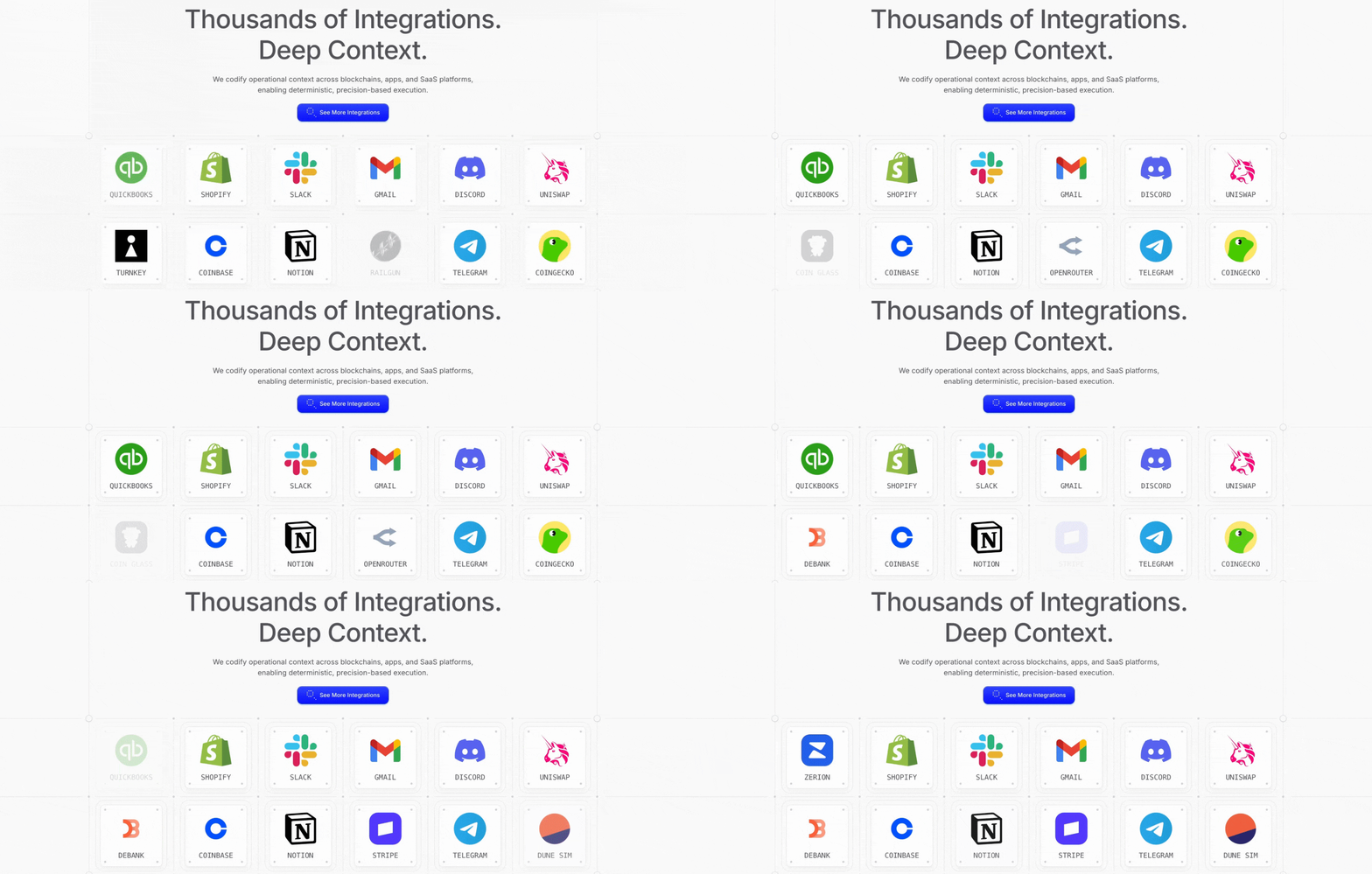
Here is the real situation most crypto-adjacent companies are in: Finance runs on Ramp. Ops runs on Notion. Growth runs on Salesforce. And then there is this whole other layer, the onchain layer, where revenue arrives as tokens, where smart contracts are executing logic, where wallets are the identity system and the payment rail at the same time.
None of these things talk to each other without a developer in the room.
You want to sync onchain revenue into your accounting? Someone has to write a script. You want to trigger a CRM update when a smart contract event fires? Someone has to build a listener. You want to automate payroll in crypto, run a trading strategy, or move funds based on a portfolio condition? That is a Solidity developer, probably a few days of work, probably held together with duct tape, and definitely a single point of failure every time the RPC changes.
Zapier cannot do this. Make.com cannot do this. n8n gives you the pieces to maybe cobble something together if you are deeply technical, but there is no native wallet, no native transaction execution, and no understanding of what "onchain" means as a concept.
B3OS was built for exactly this gap.
What B3OS Actually Is
B3OS is an automation engine, but one that treats the blockchain as a first-class citizen alongside everything else.
The mechanics will feel familiar if you have used any automation tool: you pick a trigger, you add your logic, you define your actions. Three steps. The difference is in what those steps can actually reach.
Triggers can be smart contract events. Actions can be onchain transactions. Wallets are native to the system, not bolted on. And the whole thing connects to 2,000-plus Web2 apps at the same time, so you are not choosing between the onchain world and the tools your team already lives in. You are connecting them.
The specific flows this unlocks are genuinely new territory:
- When a contract event fires, update the CRM and notify Slack
- When payslips are generated in Deel, trigger an onchain payment matching those amounts
- When a token position hits a certain PnL threshold, auto-rebalance or move to cold storage
- When a Google Sheet row is marked complete, send USDC to the wallet in that row
- Claim Clanker fees on a schedule, log the transaction, post a formatted receipt to your team
These are not hypothetical workflows. They are live.
How B3OS Compares, Specifically
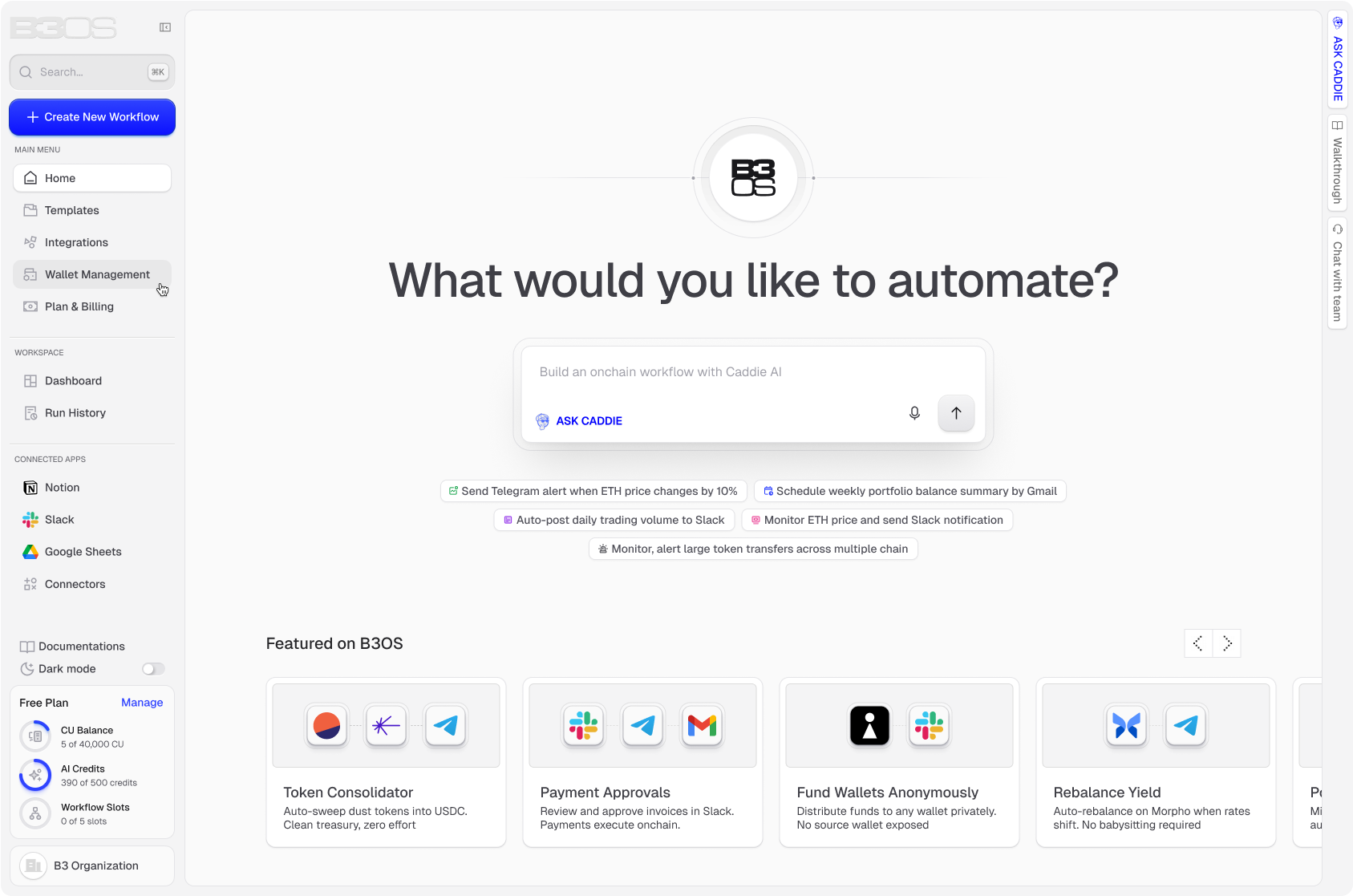
Zapier
The most mature platform in the category, and the most Web2-brained. Zapier's integrations are battle-tested and broad, and its Copilot AI has gotten genuinely good at building flows incrementally. But Zapier has no wallet concept. No onchain triggers. No transaction execution. If you want to move crypto in response to a SaaS event, Zapier gets you to the edge of the cliff and stops.
There is also a cultural thing worth naming: Zapier is a large company now, optimizing for enterprise contracts and upmarket positioning. The product is good, but it is not moving fast in directions that matter for onchain workflows.
More powerful visual builder, better for complex branching logic, still categorically Web2. Make's strength is the flexibility of its node editor, but that flexibility stops cold at the blockchain boundary. The integrations ecosystem is solid but smaller than Zapier's, and there is no native crypto layer in the roadmap as far as anyone outside the company knows.
n8n
Beloved by technical users, especially self-hosters who want control over their infra. n8n gives you a lot of rope, and you can do some clever things with its HTTP nodes and custom functions. But doing anything onchain with n8n means you are writing JavaScript to call RPC endpoints yourself, managing private keys somewhere, and basically building the wallet infrastructure that B3OS ships with out of the box. For a solo hacker who enjoys that kind of thing, fine. For a team trying to move fast, that tradeoff breaks down quickly.
Relay.app
Relay's positioning around human-in-the-loop workflows is genuinely interesting, and their focus on structured approvals and team handoffs fills a real need. But Relay is also, at its core, a Web2 tool. The "human in the loop" is a great idea. There is no version of Relay where that loop includes a multisig or a smart contract approval step.
Gumloop, Parabola, and the rest
The newer generation of AI-forward automation tools has great product sensibility. Gumloop in particular has a template gallery and an onboarding flow that the whole category should be taking notes on. But none of these are close to having native blockchain support. They are building better interfaces on top of the same Web2-only substrate.
The Part That Is Actually Hard to Copy
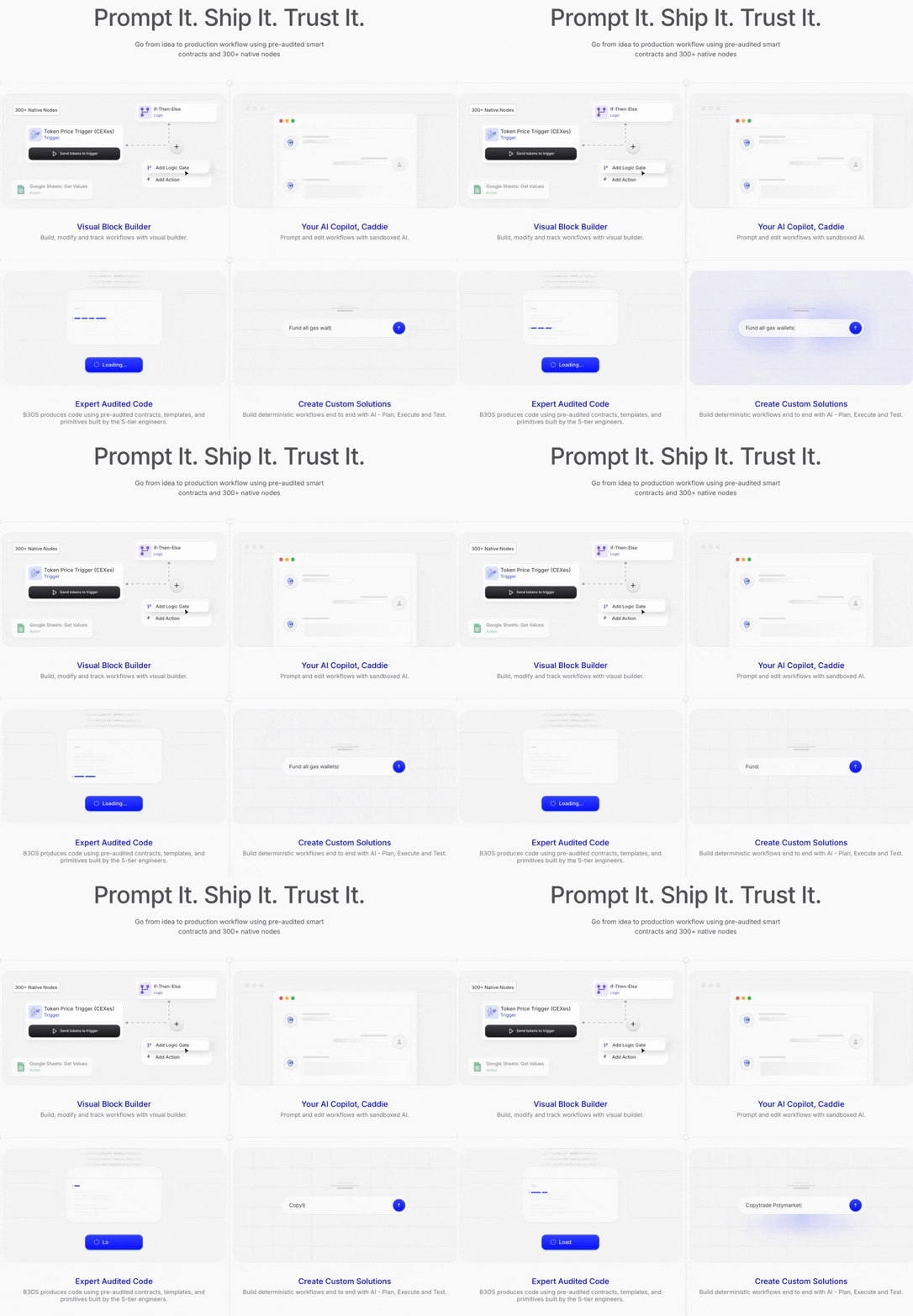
The reason B3OS is not just "Zapier but with a few crypto integrations" comes down to the wallet layer.
Moving funds onchain, executing transactions on behalf of users, triggering smart contracts, all of this requires something that Web2 automation platforms have no equivalent for: a system that can hold, manage, and act on private keys securely, at workflow runtime. B3OS handles this through Turnkey's infrastructure, which means the wallet is native to the workflow, not an external credential you are hoping nobody compromises.
This is not a feature. It is an architectural decision that determines what the platform can do at a fundamental level. You cannot add "move onchain funds" to Zapier the same way you add a Slack integration. The whole model has to be built around it from the start.
Beyond the wallet infrastructure, B3OS defaults to OpenZeppelin's audited contracts for every smart contract it writes. When customization is needed outside those standards, it goes custom. This matters for any team where a CTO or a compliance officer needs to understand what they are deploying.
Who It Is For
The honest answer right now is that B3OS serves two audiences who probably do not think of themselves as being in the same room.
The first group: builders, indie hackers, DeFi users, crypto-native startups. People who already live onchain and want automation that keeps up with them. For this group, B3OS is a way to build trading strategies, automate token management, connect their onchain life to their Web2 tools, and ship workflow-powered apps without spinning up backend infrastructure from scratch.
The second group: ops and finance teams inside companies that touch blockchain. Companies settling payments in crypto, companies running treasury strategies, companies trying to reconcile onchain revenue with their accounting systems, companies that keep pinging their dev team for automations that should not require a developer. For this group, B3OS is the layer that makes the blockchain accessible without asking everyone to become a Solidity developer.
Both groups hit the same wall with every existing automation tool: the wall where blockchain starts and the tool's capabilities end. B3OS is the first serious attempt to tear that wall down.
The Direction of Travel
Automation tooling is entering a new phase, one where AI agents are not just building workflows but running them, making decisions inside them, and being the triggers themselves. The platforms that will matter in this next phase are the ones that have both the AI-forward surface and the execution layer to act on what the AI decides.
B3OS is already building toward being an MCP (Model Context Protocol) execution layer, meaning that AI agents, including the kind running inside tools like Claude, could call into B3OS to execute onchain transactions as part of a broader agentic workflow. That is a genuinely forward-looking position. A Claude agent that can research, decide, and then actually move funds or execute a contract through B3OS is a meaningfully different thing than a Claude agent that can research and write you a memo about what it would do if it could act.
The other platforms are not thinking about this because they do not have the onchain execution layer to offer. B3OS does.
The Short Version
If your work is entirely Web2, Zapier and Make still serve you well. They are mature, reliable, and well-documented.
If anything you do touches a blockchain, whether that is your payment rails, your token treasury, your smart contract logic, or your users' wallets, none of those platforms can take you where you need to go. They do not understand the world you are working in.
B3OS does. And right now, it is the only automation platform that does.
B3OS launching this month. Templates, integrations, and the AI workflow builder are all shipping fast. The best time to get in and shape how it grows is now, before the category catches on to what it is building.